

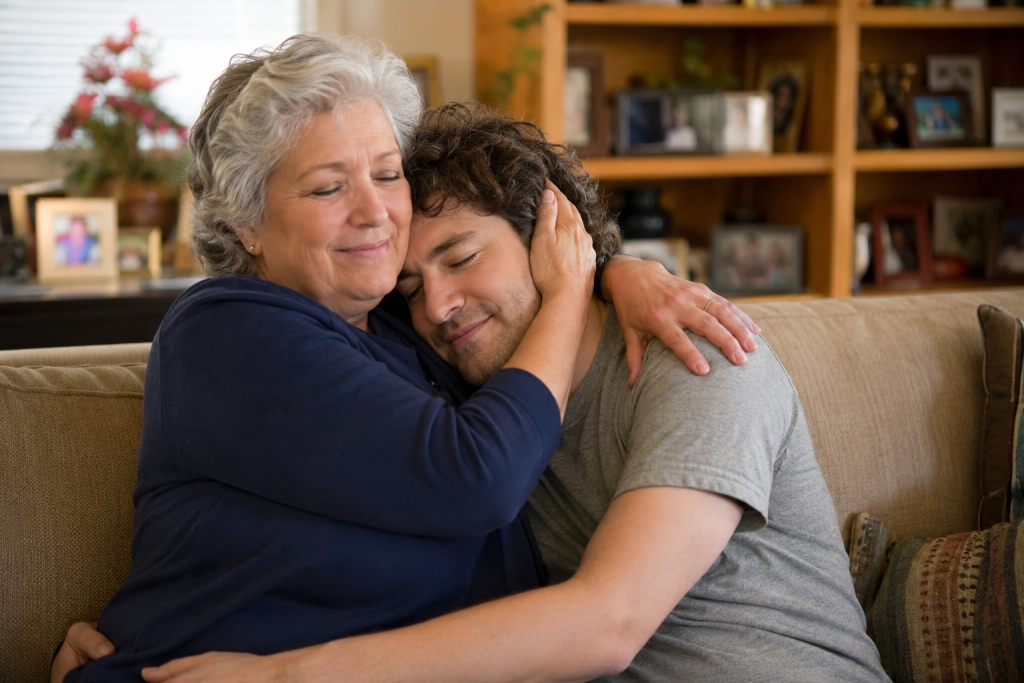

The other day my mother gave me a medicinal paste.
Not a prescription.
Not something prescribed by a doctor.
A mysterious brown substance in a tub with claims so broad it could apparently cure everything from a common cold to a horse with emotional baggage.
Naturally, I approached it with the scepticism of a marketer who has spent twenty years reading claims, disclaimers and sales pitches.
My mother approached it with the certainty of a woman who has successfully kept me alive for four decades.
You can guess who won.
The tub now sits on my bedside table.
The only reason I agreed to take it was because she also gave me a chocolate.
Which is how, at forty-something years old, I found myself accepting a reward for being a “good girl.”
I wish I was making this up.
The funny thing is that no matter how old we get, good mothers seem to possess an extraordinary ability to bypass every layer of adulthood we have carefully constructed.
I can negotiate consulting contracts.
I can present to executive teams.
I can coach clients through major life decisions.
I can navigate complex blended family dynamics.
But put me in a room with my mother and suddenly the conversation becomes:
“Have you taken the medicine?”
“No.”
“Take the medicine.”
“Can I have the chocolate now?”
And just like that, I’m eight years old again.
What’s fascinating is that this doesn’t happen because mothers infantilise us.
The really good ones don’t.
It happens because they remain one of the few people in our lives whose care has never been linked to our performance.
Think about it.
Most adult relationships are transactional in some way.
Your employer cares whether you perform.
Your clients care whether you deliver.
Your audience cares whether you add value.
Your children need you to show up.
Your partner needs your presence, attention and contribution.
Life slowly becomes a series of responsibilities, outputs and expectations.
Then along comes your mother.
She looks at the same person everyone else sees and says:
“You look tired.”
Not because she’s assessing your productivity.
Not because she’s evaluating your contribution.
Not because she’s wondering whether you’ve met your targets.
Simply because she sees you.
The child she raised.
The person she loves.
The one who still, in her eyes, occasionally needs a blanket, a cup of tea and apparently a medicinal paste.
I think that’s why it feels so comforting.
For a few moments, you don’t have to be the capable one.
You don’t have to have the answers.
You don’t have to carry everyone else.
You don’t have to be the parent, the leader, the problem-solver or the responsible adult.
You get to be somebody’s child again.
And perhaps that’s something many of us miss more than we’re willing to admit.
Because adulthood can be exhausting.
Not because the work is hard.
Not because the responsibilities are unreasonable.
But because there are very few places where we are simply cared for without expectation.
No performance review.
No scorecard.
No KPI.
No proving.
Just love.
Sometimes disguised as terrible-tasting herbal remedies.
Sometimes accompanied by chocolate.
The older I get, the more I realise that these moments are not childish at all.
They’re reminders.
Reminders that beneath all the titles, achievements, responsibilities and roles, we remain wonderfully human.
And every now and then, it’s okay to let someone else look after us.
Even if the price is swallowing something disgusting.
Especially if there’s chocolate afterwards.
And I know not everyone has been as fortunate as I have.
Not everyone has known the comfort of a mother whose love felt safe, steady and unconditional.
Some have had to navigate life without that relationship.
Others carry the grief of having lost a good mother far too soon.
So I write this with deep empathy for anyone who has missed this kind of love, or who longs for it still.
If that’s you, I hope there is someone in your life who sees you in that same way.
Not for what you do.
Not for what you achieve.
But simply for who you are.